
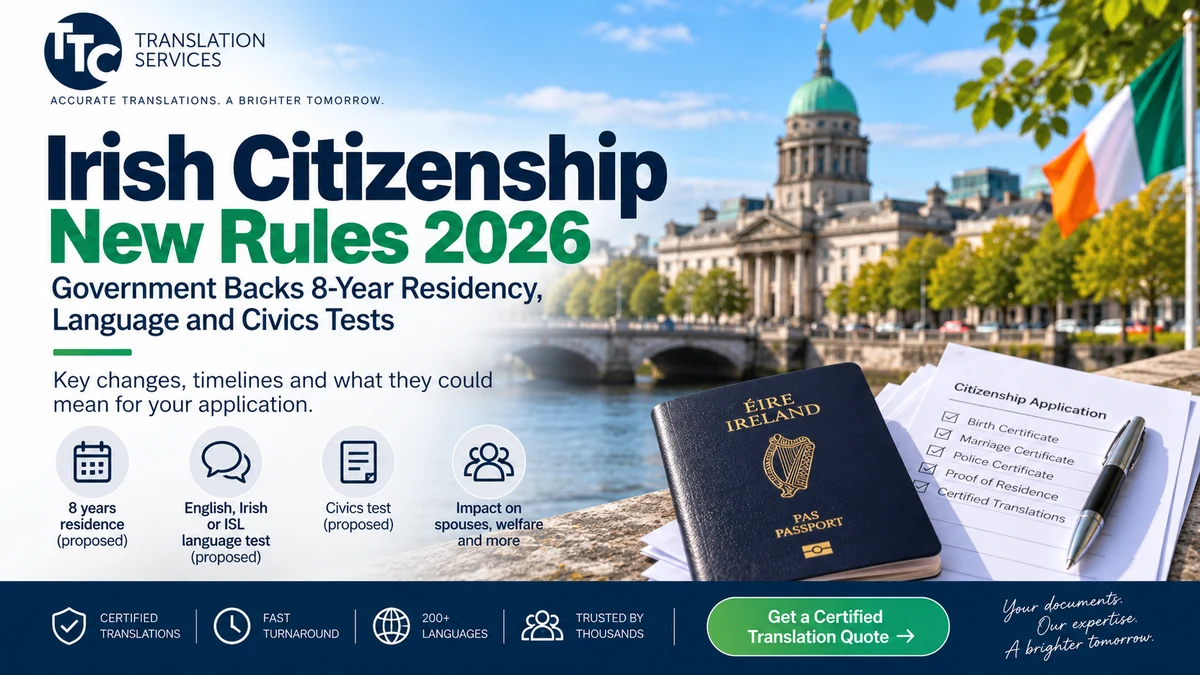
The Irish Government has backed major proposed changes to citizenship by naturalisation, including increasing the general residence requirement from five years to eight years and introducing new language, civics and financial requirements.
But there is one point anyone reading about the Irish citizenship new rules in 2026 should understand immediately:
The proposed eight-year residence rule is not in force today.
On 9 September 2026, the Government approved the priority drafting of legislation under the proposed Irish Nationality and Citizenship (Amendment) Bill 2026. That is an important step towards changing Irish citizenship law, but Cabinet approval to draft a Bill does not itself replace the existing naturalisation rules.
Current Immigration Service Delivery guidance continues to state that an adult applying for naturalisation on the basis of residence generally needs five years of reckonable residence, including one continuous year immediately before the application.
Important — 9 September 2026: The measures below are Government-backed proposals being prepared for legislation. The final Bill, commencement date, regulations and transitional provisions may change. Applicants should always check current Immigration Service Delivery guidance before acting on information about citizenship eligibility.
Irish Citizenship New Rules 2026: What Did the Government Approve?
Justice Minister Jim O’Callaghan and Minister of State for Migration Colm Brophy secured Government approval for the priority drafting of legislation intended to substantially reform Ireland’s naturalisation system.
The headline proposal is to increase the general qualifying residence period from five years to eight years.
The package also includes proposed language-proficiency requirements, a civics or foundational-knowledge requirement, economic self-sufficiency criteria, restrictions relating to certain social protection or housing supports, longer qualifying requirements for spouses and civil partners of Irish citizens, provisions relating to immigration offences and expanded citizenship-revocation powers in certain circumstances. Detailed aspects of these proposals have been reported by The Irish Times and the Irish Examiner.
The proposed legislation is being developed as the Irish Nationality and Citizenship (Amendment) Bill 2026.
Current Irish Citizenship Rules vs the Proposed Changes
| Area | Current position | Government-backed proposal |
|---|---|---|
| General reckonable residence | Five years | Eight years |
| Continuous residence immediately before applying | One year | Two years |
| Earlier residence calculation | Four years in the preceding eight | Six years in the preceding ten |
| General language-proficiency test | No equivalent general requirement | Proficiency in English, Irish or Irish Sign Language proposed |
| Civics test | No equivalent general formal test | Knowledge of Irish society, government and civic life proposed |
| Minimum-income framework | No new minimum-income rule of this proposed type | Self-sufficiency/income threshold proposed |
| Certain welfare/housing supports | No general two-year bar of the proposed type | New restrictions proposed, with details still being developed |
| Spouse/civil-partner marriage threshold | Three years | Five years proposed |
| Spouse/civil-partner continuous residence | One year | Two years proposed |
The current residence and spouse rules can be checked against Immigration Service Delivery. The proposed provisions remain subject to drafting and the legislative process.
How Would the Proposed Eight-Year Residence Rule Work?
The proposal is more specific than requiring someone to spend eight consecutive years in Ireland.
Detailed reporting says an ordinary residence-based applicant would need:
- two years of continuous residence immediately before applying; and
- six years of qualifying residence during the preceding ten years.
This compares with the current ordinary route of one continuous year immediately before application plus four years of reckonable residence during the preceding eight years.
The distinction between physical presence and reckonable residence remains important. Not every immigration permission or period spent physically in Ireland necessarily counts in the same way for naturalisation.
Applicants should therefore check current Immigration Service Delivery guidance and their individual immigration history rather than simply counting calendar years.
Will Applicants Have to Speak Both English and Irish?
No.
This has been one of the easiest parts of the announcement to misunderstand.
The reported proposal is that applicants would demonstrate proficiency in English, Irish or Irish Sign Language. The Irish Times reported the three-language option, while RTÉ has examined the proposed language-testing approach.
It is therefore not a proposal requiring every applicant to become proficient in both English and Irish.
The exact proficiency level, approved examinations and testing arrangements have not yet been finalised publicly.
Applicants should therefore be cautious about paying for a course or examination advertised as the definitive “Irish citizenship language test” before official requirements are published.
What Would the Proposed Citizenship Civics Requirement Cover?
A separate proposed requirement would ask applicants to demonstrate foundational knowledge and understanding of Irish civic life.
Current reporting indicates that this could cover areas such as Irish society, government, politics, the Constitution and how the institutions of the State operate. This requirement would be distinct from the language-proficiency requirement.
As of 9 September 2026, a final public examination format, official preparation handbook and pass standard have not been published.
What Are the Proposed Income and Self-Sufficiency Requirements?
Economic self-sufficiency is another significant part of the planned reforms.
The proposals would allow the Minister for Justice to set an income level that applicants must meet. Reporting indicates that the threshold could take account of factors such as Central Statistics Office earnings data, labour costs and the cost of living.
No final qualifying salary figure has yet been published.
Applicants should therefore be careful with websites, videos or social-media posts presenting a specific income amount as if it were already the legal Irish citizenship threshold.
Will Receiving Social Welfare Prevent Someone From Becoming an Irish Citizen?
The Government package includes proposals relating to certain social protection and housing supports, but this area requires particularly careful interpretation because the detailed categories and exceptions are not yet final.
According to The Irish Times, long-term unemployment assistance and some housing supports have been identified as potentially relevant, while Child Benefit and maternity-related payments are not expected automatically to prevent an application.
It would therefore be inaccurate to say that receiving any form of social welfare automatically disqualifies someone from citizenship.
The final legislation and accompanying regulations will be important in determining exactly how these rules operate.
What Changes Are Proposed for Spouses and Civil Partners of Irish Citizens?
The Government package would also tighten the naturalisation route for spouses and civil partners of Irish citizens.
Under the current framework, the couple must generally have been married or in a civil partnership for at least three years, and the applicant must meet the existing three-year residence framework.
Under the reported proposal:
- the marriage or civil-partnership threshold would increase from three years to five years;
- the applicant would need two continuous years of residence immediately before applying;
- plus three years of residence during the preceding five years; and
- the proposed language and civic-knowledge requirements would also apply.
These remain proposed changes rather than the rules currently in force.
Will the Eight-Year Rule Affect People Already Living in Ireland?
The Government’s current intention appears to be that it could.
The Irish Examiner reported that people already resident in Ireland who have not submitted a naturalisation application before the new legislation commences may become subject to the longer qualifying period. Residence already accumulated is expected to count towards the proposed eight-year threshold.
However, the final transitional provisions must be checked in the legislation itself.
Until the Bill and commencement provisions are available, it would be premature to describe the position of every person already living in Ireland as definitively settled.
Anyone approaching eligibility under the existing rules who believes the timing of the legislation could materially affect them should check their current reckonable residence and consider qualified immigration or legal advice where appropriate.
What Would the Proposals Mean for Ukrainians Under Temporary Protection?
Current reporting indicates that time spent in Ireland under the EU Temporary Protection Directive would not count towards the proposed naturalisation residence calculation.
This is particularly relevant to Ukrainians who have been living in Ireland under Temporary Protection. Different immigration permissions can be treated differently for the purpose of reckonable residence, so applicants should follow the latest official Immigration Service Delivery guidance rather than assuming that every period spent physically in Ireland counts equally towards naturalisation.
What Is Proposed Regarding Immigration Offences and Citizenship Revocation?
The reform package also contains stricter proposals relating to immigration-law compliance and citizenship revocation.
Detailed reporting indicates that an immigration offence committed before or during an application could prevent a grant of citizenship under the proposed system. The package would also provide additional grounds relating to public order and national security for the revocation of citizenship.
The precise statutory wording will be important for legal interpretation, so these provisions should be reassessed when the actual Bill is published.
Are the New Irish Citizenship Rules Law Yet?
No.
Government approval for priority drafting is not the same thing as enactment.
The Houses of the Oireachtas explains that, after Government approval to draft, a Department normally sends drafting instructions to the Office of the Parliamentary Counsel and the general scheme may undergo pre-legislative scrutiny.
A Bill then has to pass through the legislative stages in both Houses. The Oireachtas procedure guide explains that a Bill must complete the required stages in the Dáil and Seanad before it can be enacted and sent to the President for signature.
For that reason, the current five-year naturalisation framework remains the appropriate starting point as of 9 September 2026.
When Could the Proposed Citizenship Changes Take Effect?
The Irish Examiner has reported that senior Government sources expected the reforms to be passed before the end of 2026.
That is a political and legislative expectation, not a guaranteed commencement date.
The Bill still needs to go through drafting and the Oireachtas process, and the resulting Act may itself contain commencement provisions.
Anyone planning around a particular date should therefore rely on enacted legislation and official commencement information rather than an expected timetable reported before the legislative process is complete.
Why Is the Government Proposing These Changes?
The Government has presented the reforms as a way to require a stronger and more durable connection with Ireland, with greater emphasis on lawful and sustained residence, integration, civic participation, economic self-sufficiency and compliance with immigration law.
Migrant and civil-rights organisations have criticised aspects of the proposals, particularly the longer residence period and financial or welfare-related conditions. The political and legal debate is therefore likely to continue during the drafting and parliamentary stages.
Do Documents for an Irish Citizenship Application Need Certified Translation?
The proposed reforms do not remove the need to follow current Immigration Service Delivery document and translation requirements.
The official How to Become an Irish Citizen Guide states that if a required document is not in English or Irish, the applicant must include a translation from a professional translation service and upload both the certified translation and a copy of the original document.
Depending on the citizenship route and the applicant’s circumstances, supporting documents can include birth certificates, marriage certificates, divorce documents, civil-status documents, police or criminal-record documents and other identity or family records.
There is an important exception for certain public documents issued within the EEA or Switzerland. ISD’s certified translation guidance explains that an eligible Multilingual Standard Form (MSF) can remove the need for translation of certain qualifying public documents. If an appropriate MSF is not provided, translation into English or Irish may still be required.
TTC provides certified translation services in Ireland for customers who need supporting documents translated for citizenship, immigration and other official applications.
TTC’s role is the translation of documents. TTC is a private translation company and does not decide citizenship applications or guarantee that an underlying citizenship or immigration application will be approved.
For broader questions about certification, documents and official use, see our certified translation FAQs.
What Should Prospective Citizenship Applicants Do Now?
If you are preparing for naturalisation, the most important step is to distinguish between today’s requirements and measures that may apply only after new legislation commences.
- Check your current eligibility against official Immigration Service Delivery guidance.
- Confirm your reckonable residence rather than relying solely on the number of calendar years you have lived physically in Ireland.
- Use the current document checklist for your particular route.
- If a required document is not in English or Irish, check whether a professional certified translation is required and whether a Multilingual Standard Form may apply.
- Do not assume that a language-test provider, civics course, salary figure or welfare rule circulating online is official unless the relevant requirement has been formally published.
- If timing or transitional provisions could materially affect your legal position, consider advice from a suitably qualified immigration solicitor or adviser.
Frequently Asked Questions
Has Ireland already changed the citizenship residence requirement from five years to eight years?
No. On 9 September 2026, the Government approved priority drafting of legislation proposing the change. Current Immigration Service Delivery guidance still reflects the five-year ordinary naturalisation route. The proposed eight-year rule would need to be enacted and brought into force before replacing the existing requirement.
What is the proposed Irish citizenship eight-year rule?
Detailed reporting indicates that the ordinary route would require two continuous years of residence immediately before applying plus six years of qualifying residence during the preceding ten years. The final calculation should be checked against the enacted legislation once it is published.
When will the new Irish citizenship rules start?
There is no guaranteed commencement date yet. The Government wants to progress the legislation quickly, but the Bill must still go through the legislative process. Applicants should rely on the final Act and official commencement information rather than expected dates reported beforehand.
Do applicants have to speak both English and Irish?
No. The proposal is for proficiency in English, Irish or Irish Sign Language, rather than proficiency in both English and Irish. The required proficiency level and approved testing arrangements have not yet been published.
Is there already an Irish citizenship civics test I can study for?
No final official examination or preparation handbook has been introduced under these proposals as of 9 September 2026. The Government intends applicants to demonstrate knowledge of Irish society, government and civic life, but the detailed test format still has to be established.
Is there a minimum salary for Irish citizenship now?
No new statutory salary figure under these proposals is currently in force. A self-sufficiency or minimum-income requirement is proposed, but the final threshold has not yet been published.
Will Child Benefit stop someone applying for Irish citizenship?
Current reporting indicates that Child Benefit and maternity-related payments are not expected automatically to prevent an application. Long-term unemployment assistance and certain housing supports may be treated differently. The final categories and exceptions should be checked once legislation and regulations are published.
Will the new eight-year rule affect someone already close to five years?
The Minister has indicated that the intended longer residence rule could affect people already living in Ireland who have not submitted an application before the new law commences. However, the final transitional provisions must be checked in the legislation.
What changes are proposed for spouses of Irish citizens?
The proposal would increase the marriage or civil-partnership threshold from three years to five years and introduce longer residence requirements, reportedly including two continuous years before application plus three years during the preceding five years. These are proposed rules rather than the current requirements.
Does time under Temporary Protection count towards the proposed eight-year rule?
Current reporting indicates that time spent under the EU Temporary Protection Directive would not count towards naturalisation under the proposed framework. Different future immigration permissions may be treated differently, so applicants should check current official guidance for their particular status.
Do I need a certified translation for documents in an Irish citizenship application?
Current ISD guidance says that required documents not in English or Irish must be accompanied by a translation from a professional translation service, with the certified translation submitted together with the original document copy. Certain qualifying EEA or Swiss public documents accompanied by a Multilingual Standard Form may not require translation.
Need a Certified Translation for Your Citizenship Documents?
If a birth certificate, marriage certificate or another required supporting document needs translation for an Irish citizenship application, TTC can review the document and the receiving authority’s instructions and provide the appropriate certified translation service.
Send a clear scan or PDF and tell us the document language and intended use. TTC can confirm the translation options, price and available turnaround before you proceed.
TTC provides translation services only. This article is general information and is not immigration or legal advice. Citizenship rules can change, so always check current Immigration Service Delivery guidance or obtain qualified professional advice where necessary.

